Pooler
CODE
GBDA 301 Final Project
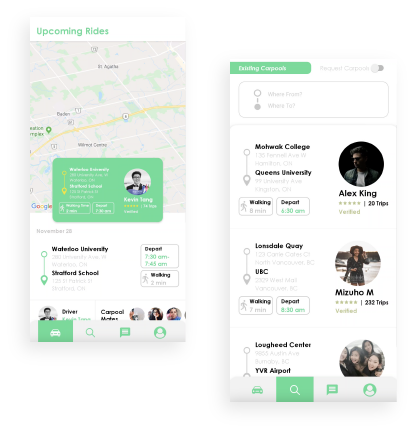
A mobile rideshare application that provides passengers with consistent reliable rides, and drivers with solution to cost calculation and payment receiving capabilities
Team
- Kevin Tang
Front-End
- React Native
- Axios
- Expo
Ideation
I wanted to explore mobile development after having done work strictly on the web. Once we got our syllabus for GBDA 301, I had asked my friend Kevin if he wanted to do a project of our own for this course, he said yes and quickly we got to thinking what kind of solution we wanted to solve. Due to the fact that all the classes were located in Stratford for the third years, Kevin had been driving our friends almost every single day. He was explaining to me how it was challenging for him to calculate how much everyone owed by the end of every month (e.g. sick days/missing class). We took his pain point and used it as our starting point in ideation.
Our project proposal was for a mobile application that aimed to make record-keeping for carpooling easier to create and upkeep; allowing for the driver to update due payments consistently, to give riders better access to information on their payment 'tabs'.
Brainstorm + First Iteration
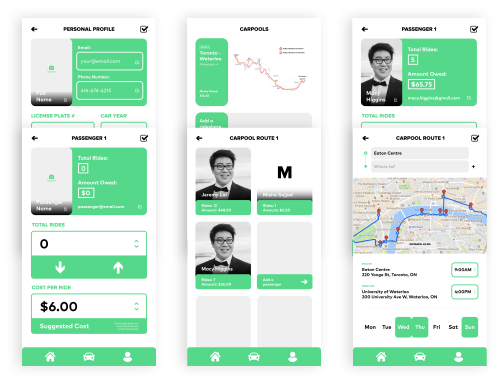
Kevin tackled the design for this project. For our first quick deadline, he drafted a simple and easy to use design on how the application would work and the features that would be included in it.
Core Features
• Two Seperate Users (Driver & Passengers)
• Drivers are able to create rides, add passengers, and access each profile to set ride count and costs.
• Ability to find long-term carpool rides
We also wanted to eventually work on short term ride-shares without competing with services like Uber. We wanted to eliminate the need for the rideshare groups on Facebook and look for more thrifty carpool options.
Development
Using Expo, I developed the app using React Native. After using React on web, I realized that the learning curve wasn’t difficult at all. However, I did feel a lot of restrictions implementing certain components and open source libraries within the application.
We had around two weeks to completely learn, design, and execute this project so we tried to keep it simple by having a fully functional front-end. But I also wanted to tackle a small challenge when exploring react native by implementing a working map api/geocode for routing destinations
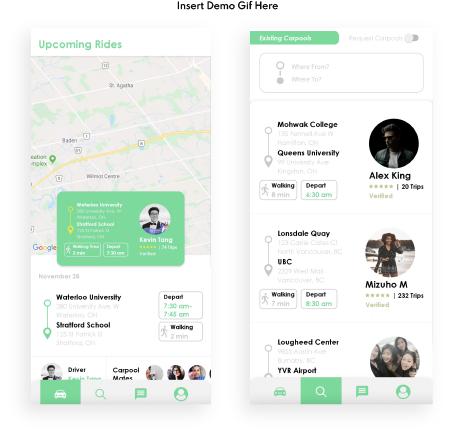
This project was a short sprint that Kevin and I wanted to tackle. Although this project was meant to be finished in a short amount of time, we had to make quick cut decisions for every dilemma we came across to hand in a functional project. React Native was definitely something I wanted to keep exploring, each page felt more independent than it did on the web which caused me to run into problems dealing with data.